Daniele Avenoso1, Natalia Difrancesco1, Enrico Morello1, Gabriele Magliano1, Mirko Farina1, Vera Radici1, Shreyas Hanmantgad2, Simona Bernardi1, Federica Re1, Alessandro Leoni1, Domenico Russo1 and Michele Malagola1
.
1
Unit of Blood Diseases and Bone Marrow Transplantation, Department of
Clinical and Experimental Science, University of Brescia, ASST Spedali
Civili di Brescia, Brescia, Italy
2 King’s College Hospital, Department of Haematological Medicine, Denmark Hill, London, United Kingdom
Correspondence to:
Prof. Daniele Avenoso, Unit of Blood Diseases and Bone Marrow
Transplantation, Department of Clinical and Experimental Science,
University of Brescia, ASST Spedali Civili di Brescia, Brescia, Italy,
E-mail: daniele.avenoso@unibs.it
Published: July 01, 2026
Received: May 07, 2026
Accepted: June 18, 2026
Mediterr J Hematol Infect Dis 2026, 18(1): e2026059 DOI
10.4084/MJHID.2026.059
This is an Open Access article distributed
under the terms of the Creative Commons Attribution License
(https://creativecommons.org/licenses/by-nc/4.0),
which permits unrestricted use, distribution, and reproduction in any
medium, provided the original work is properly cited.
|
Dear Editor
Cytokine
release syndrome (CRS) following haploidentical hematopoietic stem cell
transplantation (haplo-HSCT) is frequent but poorly characterized, and
its prognostic significance remains controversial.[1,2,3,4]
In this single-center study, we show that CRS is associated with
improved overall survival, particularly in patients transplanted beyond
first complete remission (CR1), without increasing transplant-related
mortality (TRM). Haploidentical HSCT with post-transplant
cyclophosphamide (PTCy) is increasingly used in patients lacking
matched donors.[5] Early post-infusion inflammatory
syndromes resembling CRS are commonly observed and share clinical and
biological features with immune effector cell-associated CRS.[2]
However, whether CRS reflects beneficial immune activation
(graft-versus-leukemia, GVL) or harmful toxicity remains unclear. We
retrospectively analyzed 104 consecutive patients undergoing haplo-HSCT
between July 2008 and September 2024. The study was conducted in
accordance with the Declaration of Helsinki. All patients provided
written informed consent for transplantation procedures and for the use
of anonymized clinical data for research purposes, in accordance with
institutional policy. All patients received GVHD prophylaxis with PTCy,
mycophenolate mofetil and tacrolimus as previously described.[6]
After excluding 18 patients with early-documented infections during the
early post-transplant period, 86 patients were evaluable for CRS
assessment. This exclusion was intended to reduce potential
misclassification between infectious fever and CRS, although it may
have introduced some selection bias. CRS was defined according to ASTCT
criteria in the absence of alternative causes.[7] The
primary endpoint was overall survival (OS); secondary endpoints
included relapse-free survival (RFS), GVHD/relapse-free survival
(GRFS), cumulative incidence of relapse (CIR), and TRM. Relapse and TRM
were analyzed using a competing risk framework. Given the sample size,
the analysis focused on unadjusted comparisons. Most CRS events were
grade 1–2 according to ASTCT criteria (43 out of 44), while high-grade
CRS was uncommon (1 out of 44). Owing to the limited number of severe
CRS events, a stratified analysis according to CRS grade was not
feasible and should be considered a limitation of the study. In the
overall cohort, OS was numerically higher in patients with CRS,
although this did not reach statistical significance (median not
reached vs 24 months; p = 0.10). Similarly, no significant differences
were observed in GRFS or RFS between groups. In contrast, in patients
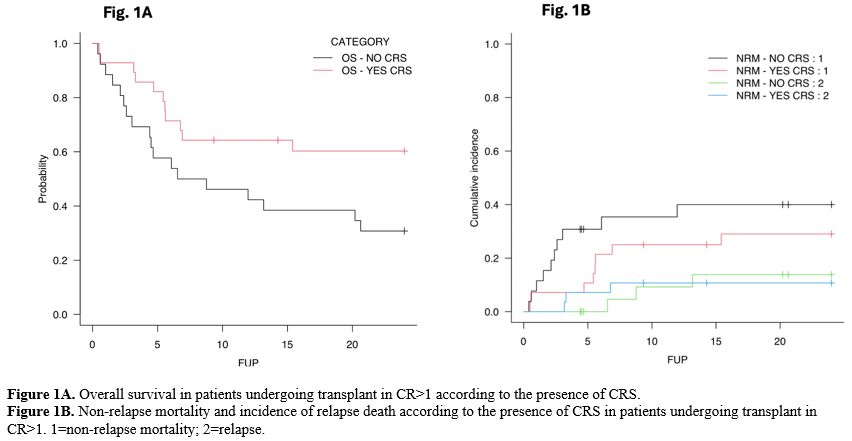
transplanted beyond CR1 (62.5% of the cohort), CRS was significantly
associated with improved OS (median not reached vs 7.6 months; p = 0.02
– Figure 1A). In this
subgroup, RFS (median not reached vs 6.7 months; p = 0.06) and GRFS
(median 39.9 vs 6.9 months; p = 0.09) also showed consistent trends in
favor of CRS, although these differences did not reach statistical
significance. When relapse was analyzed using a competing-risk
approach, the cumulative incidence of relapse was numerically lower in
patients with CRS in both the overall cohort and the advanced-disease
subgroup; however, these differences were not statistically
significant. TRM was comparable between groups (p > 0.5 – Figure 1B),
with no evidence of increased early mortality in patients developing
CRS. No significant differences were observed in the incidence or
severity of acute and chronic GVHD. These findings may suggest that
early inflammatory activation associated with CRS does not necessarily
translate into increased clinically significant alloreactivity.[8]
From a biological perspective, CRS may represent the clinical correlate
of early donor immune activation, characterized by cytokine release and
expansion of T and natural killer cells. This early alloimmune
activation could potentially contribute to disease control,
particularly in patients with residual disease at transplant, although
this hypothesis remains speculative.
 |
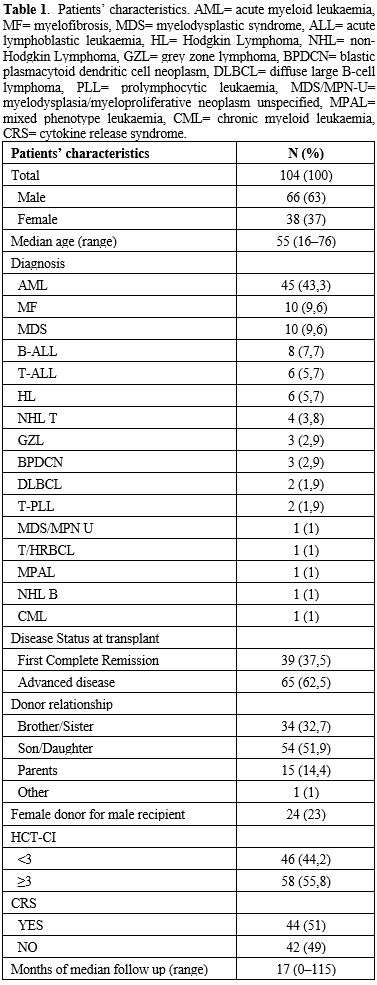
Table 1.
Patients’ characteristics. AML= acute myeloid leukaemia, MF=
myelofibrosis, MDS= myelodysplastic syndrome, ALL= acute lymphoblastic
leukaemia, HL= Hodgkin Lymphoma, NHL= non-Hodgkin Lymphoma, GZL= grey
zone lymphoma, BPDCN= blastic plasmacytoid dendritic cell neoplasm,
DLBCL= diffuse large B-cell lymphoma, PLL= prolymphocytic leukaemia,
MDS/MPN-U= myelodysplasia/myeloproliferative neoplasm unspecified,
MPAL= mixed phenotype leukaemia, CML= chronic myeloid leukaemia, CRS=
cytokine release syndrome.
|
 |
Figure 1A. Overall survival in patients undergoing transplant in CR>1 according to the presence of CRS. Figure 1B. Non-relapse
mortality and incidence of relapse death according to the presence of
CRS in patients undergoing transplant in CR>1. 1=non-relapse
mortality; 2=relapse.
|
Notably,
no patients received specific treatment for CRS, and clinical
manifestations resolved after post-transplant cyclophosphamide
administration. This observation supports the hypothesis that CRS in
this setting is driven by early alloimmune activation, subsequently
modulated by PTCy, as suggested by other groups.[9-11]
This
study has several limitations, including its retrospective design,
single-center setting, and limited sample size, particularly for
subgroup analyses. In addition, the cohort was heterogeneous and
included different hematologic malignancies with distinct relapse risks
and potentially different sensitivities to graft-versus-leukemia
effects. The relatively small number of severe CRS cases also precluded
a meaningful analysis according to CRS grade. Finally, the exclusion of
patients with early documented infections, although intended to improve
diagnostic specificity for CRS, may have introduced selection bias. In
conclusion, CRS after haplo-HSCT was associated with improved survival
in patients with advanced disease, without evidence of increased TRM.
These findings suggest that CRS may reflect early alloimmune activation
after transplantation; however, the retrospective design, limited
sample size, and cohort heterogeneity preclude definitive conclusions
regarding a graft-versus-tumor effect. Larger prospective studies are
needed to validate these observations.
References
- Abboud, R. et al. Cytokine release syndrome after
haploidentical hematopoietic cell transplantation: an international
multicenter analysis. Bone Marrow Transplant 56, 2763-2770 (2021). https://doi.org/10.1038/s41409-021-01403-w PMid:34262142
- McCurdy,
S. R. et al. Early Fever after Haploidentical Bone Marrow
Transplantation Correlates with Class II HLA-Mismatching and
Myeloablation but Not Outcomes. Biol Blood Marrow Transplant 24,
2056-2064 (2018). https://doi.org/10.1016/j.bbmt.2018.06.004 PMid:29909152 PMCid:PMC6385878
- Modi,
D. et al. Grade 3-4 cytokine release syndrome is associated with poor
survival in haploidentical peripheral blood stem cell transplantation.
Leuk Lymphoma 62, 1982-1989 (2021). https://doi.org/10.1080/10428194.2021.1891231 PMid:33627028
- Wachsmuth,
L. P. et al. Posttransplantation cyclophosphamide prevents
graft-versus-host disease by inducing alloreactive T cell dysfunction
and suppression. J Clin Invest 129, 2357-2373. https://doi.org/10.1172/JCI124218 PMid:30913039 PMCid:PMC6546453
- McCurdy,
S. R. & Luznik, L. How we perform haploidentical stem cell
transplantation with posttransplant cyclophosphamide. Blood 134,
1802-1810 (2019). https://doi.org/10.1182/blood.2019001323 PMid:31751485 PMCid:PMC6872960
- Avenoso,
D. et al. Haploidentical Transplant with Post-Transplant
Cyclophosphamide for Acute Myeloid Leukaemia and Myelodysplastic
Syndromes Patients: The Role of Previous Lines of Therapy. Mediterr J
Hematol Infect Dis 16, e2024002 (2024). https://doi.org/10.4084/MJHID.2024.002 PMid:38223487 PMCid:PMC10786144
- Lee,
D. W. et al. ASTCT Consensus Grading for Cytokine Release Syndrome and
Neurologic Toxicity Associated with Immune Effector Cells-NC-ND
license. (http://creativecommons.org/licenses/by-nc-nd/4.0/). Biology
of Blood and Marrow Transplantation 25, 625-638 (2019). https://doi.org/10.1016/j.bbmt.2018.12.758 PMid:30592986 PMCid:PMC12180426
- Shapiro,
R. M. et al. Cytokine release syndrome in haploidentical stem cell
transplant may impact T-cell recovery and relapse. Blood Adv 7,
4080-4088 (2023). https://doi.org/10.1182/bloodadvances.2023009657 PMid:37216223 PMCid:PMC10388727
- Benavente,
R. et al. Cytokine release syndrome: implications for transplant
outcomes in haploidentical and HLA-matched HSCT using PTCy. Bone Marrow
Transplant 60, 1020-1026 (2025). https://doi.org/10.1038/s41409-025-02594-2 PMid:40269279
- Kitamura,
W. et al. Feasibility of early tacrolimus initiation in
haploidentical-PBSCT with post-transplant cyclophosphamide after
melphalan-based conditioning regimen. Blood Cell Ther 8, 262-267
(2025). https://doi.org/10.31547/bct-2025-013 PMid:41368186 PMCid:PMC12682609
- Koh,
J. S. et al. Post-transplant cyclophosphamide plus anti-thymocyte
globulin decreased serum IL-6 levels when compared with post-transplant
cyclophosphamide alone after haploidentical hematopoietic stem cell
transplantation. Blood Res 60, 5 (2025).
https://doi.org/10.1007/s44313-024-00049-z PMid:39812969 PMCid:PMC11735700